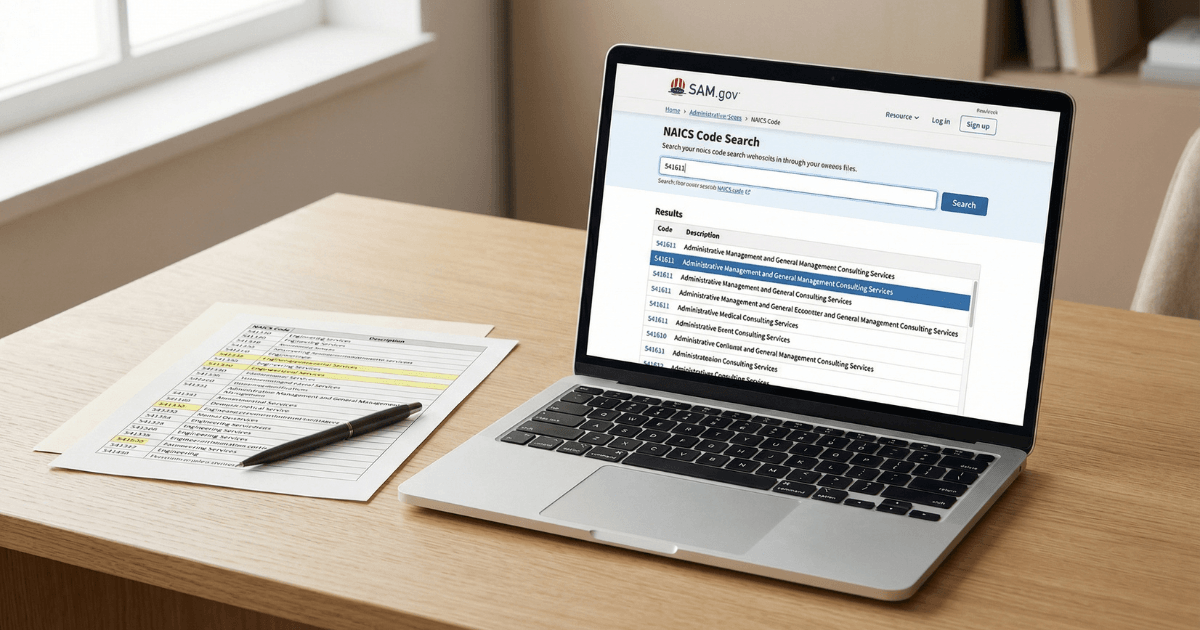
Your NAICS codes in SAM do two things that directly affect your federal contracting results: they determine whether contracting officers find you when searching for vendors, and they establish your size standard for small business set-aside eligibility. Most businesses pick codes quickly and move on — but a misaligned primary NAICS code can make you invisible to the buyers most likely to award you work, and an incorrect size standard certification can create compliance problems. This guide covers how to choose your primary NAICS code, when to add secondary codes, and the mistakes that reduce your visibility and eligibility.
For the complete SAM.gov registration workflow — UEI, entity validation, Reps & Certs, and EFT setup — see the SAM.gov registration guide for small businesses.
On this page Jump to section
NAICS Codes in SAM.gov: Quick Answer
NAICS (North American Industry Classification System) codes classify your business by industry and are used in SAM.gov for two critical purposes: determining your SBA size standard for small business eligibility, and helping contracting officers find your business during market research. Your primary NAICS code should reflect your core offering. Secondary codes can be added for genuine supporting capabilities — but accuracy and relevance matter far more than volume.
What NAICS Codes Do in Federal Contracting
NAICS codes serve two distinct functions in your SAM registration — and both have direct consequences for your results in federal contracting.
Function 1: Size standard determination
The SBA assigns size thresholds — measured by annual revenue or employee count, depending on the industry — to each NAICS code. These thresholds determine whether your business qualifies as "small" for a given contract opportunity. Every set-aside solicitation designates a NAICS code, and your size certification under that code determines your eligibility to compete as a small business.
Your primary NAICS code in SAM.gov is the code used to establish your baseline size certification in your Representations & Certifications. If the code doesn't accurately reflect your business, your size certification may be based on the wrong threshold.
Function 2: Vendor discoverability
Contracting officers conduct market research using SAM.gov's vendor search tools. NAICS code is one of the primary filters they use to find vendors qualified for their requirement. If your SAM profile doesn't include the NAICS code associated with a solicitation, you may be missed entirely during the research phase — even if your capabilities are a strong fit.
For a deeper look at how buyers actually search and what they look for when they find a vendor profile, see how contracting officers find vendors.
How NAICS codes are structured
NAICS codes are hierarchical and six digits long at the most specific level. The more digits, the more precisely the code describes the work.
NAICS hierarchy — example: IT consulting
Always select the most specific six-digit code that accurately describes your work. Overly broad codes reduce relevance in buyer searches and may not align with the codes on solicitations you want to pursue.
How to Choose Your Primary NAICS Code
Your primary NAICS code carries the most weight of any code in your SAM profile. It is the code used for your size standard baseline certification, the most prominent code in your entity record, and the first code buyers see when they find your profile. Take more time on this decision than it might initially seem to warrant.
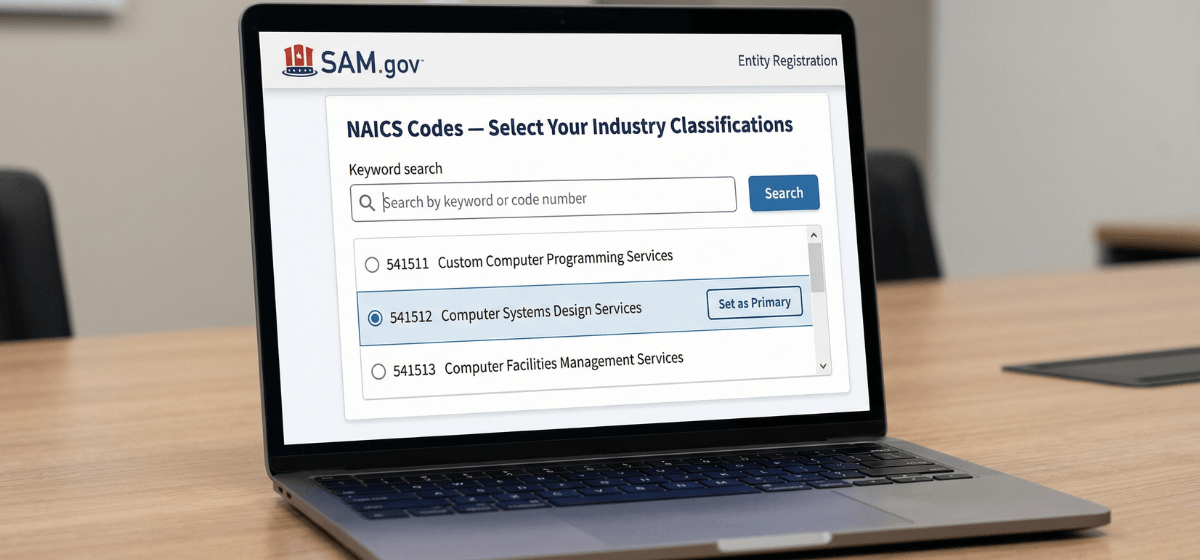
Write down what your business primarily does and what it primarily delivers. Be specific. "We provide IT support and managed services to federal agencies" is useful. "We provide comprehensive technology solutions" is not. The more specific your description, the more precisely you can match it to a code.
Search using specific keywords from your plain-language description — not by browsing broad industry sectors. Sector browsing tends to produce codes that are too general. Keyword search surfaces the specific six-digit codes most relevant to your actual work.
From your search results, identify the six-digit national industry code that most precisely describes your core business activity. If two codes both seem applicable, choose the one that most accurately reflects where most of your revenue comes from.
Look up your code on the SBA size standards table (sba.gov). Confirm you understand whether the standard is revenue-based or employee-based, and what the specific threshold is. This is the threshold that applies to your Reps & Certs size certification — an error here affects your set-aside eligibility on every solicitation under that code.
Search SAM.gov contract opportunities (sam.gov/opportunities) using the NAICS code you're considering. Review the results: do the solicitations reflect the kind of work you actually pursue? If yes, the code is a strong fit. If the results look like work you'd never bid on, reconsider. Your NAICS code should align with the solicitations you want to pursue — not just your business description in the abstract.
Secondary NAICS Codes: When to Add Them and When to Stop
Secondary NAICS codes extend your discoverability to solicitations in areas where you have genuine, documented capability beyond your primary offering. They are not a tool for maximizing coverage — they are a tool for accurately representing additional capabilities you actively pursue and can demonstrate.
- You have documented experience under that code
- You actively pursue contracts in that area
- The solicitations under that code reflect work you want and can perform
- You can point to past performance in that category
- It sounds adjacent or aspirational
- You have no experience or past performance there
- You're trying to cover every possible opportunity type
- You're adding it because the size standard is more favorable
The overstuffing problem
Adding a large number of NAICS codes — especially codes that don't align with your actual capabilities — reduces the relevance of your profile to buyers conducting targeted searches. Contracting officers doing market research want to find vendors who are clearly aligned with their specific requirement. A profile with 15 loosely related codes signals that the business hasn't done the work of understanding what it actually does best.
Most small businesses are well-served by 1 primary NAICS code and 2–4 carefully chosen secondary codes. More than that requires a strong justification based on actual, demonstrable capability and past performance — not aspiration.
Common NAICS Code Mistakes in SAM Registration
What to Do After Choosing Your NAICS Codes
NAICS code selection checklist
Confirm all of these before finalizing your SAM registration.
Once your NAICS codes are set and your registration is Active, the next priority is making sure your full SAM profile works as a buyer discovery tool — narrative, keywords, and classification all aligned with how buyers search. See how to optimize your SAM profile for buyer visibility for the next step.
Frequently Asked Questions About NAICS Codes in SAM
What is a NAICS code in SAM.gov?
A NAICS (North American Industry Classification System) code classifies your business by industry. In SAM.gov, your NAICS codes serve two functions: they determine your SBA size standard for small business set-aside eligibility, and they affect how contracting officers find your business during market research. NAICS codes are defined by the U.S. Census Bureau and are six digits long at the most specific level.
How many NAICS codes should I add to SAM.gov?
Most small businesses are well-served by 1 primary NAICS code and 2–4 carefully chosen secondary codes that reflect genuine, current capabilities. Adding many loosely related codes reduces the relevance of your profile to buyers conducting targeted searches and signals a lack of focus to contracting officers reviewing your entity record.
What is the primary NAICS code used for?
Your primary NAICS code is the main code used to determine your SBA size standard baseline for small business eligibility certifications in your Reps & Certs. It is also the most prominent code in your SAM entity record and the primary code buyers see when they find your profile. It should reflect your business's core revenue-generating activity — not the broadest or most aspirational description of your capabilities.
Can I change my NAICS codes after registration?
Yes. NAICS codes can be updated in SAM.gov during the annual renewal process or as a mid-cycle record update if your business has significantly changed. Review and update your codes at every annual renewal to ensure they still accurately reflect your current core offering and the solicitations you are actively pursuing.
How do NAICS codes affect small business set-aside eligibility?
Each NAICS code has an associated SBA size standard — a revenue or employee threshold that determines whether a business qualifies as "small" for that code. When a set-aside solicitation is issued, it designates a specific NAICS code. Your size certification under that code determines whether you're eligible to compete as a small business on that opportunity. An incorrect primary NAICS code in your SAM registration can result in a size certification that doesn't apply to the solicitations you're actually pursuing.
Not sure your NAICS codes are aligned with the work you want to win?
NAICS selection is one of the highest-leverage decisions in your SAM registration — and one of the most commonly rushed. If you want an experienced review of your code selection before finalizing your registration, or a done-for-you registration that handles NAICS selection as part of the full workflow, the options below are the fastest path forward.
Author: Biz2Gov Editorial Team · Reviewed by: Former DoD Contracting Officer advisor · Sources: U.S. Census Bureau NAICS, SBA size standards, SAM.gov opportunities