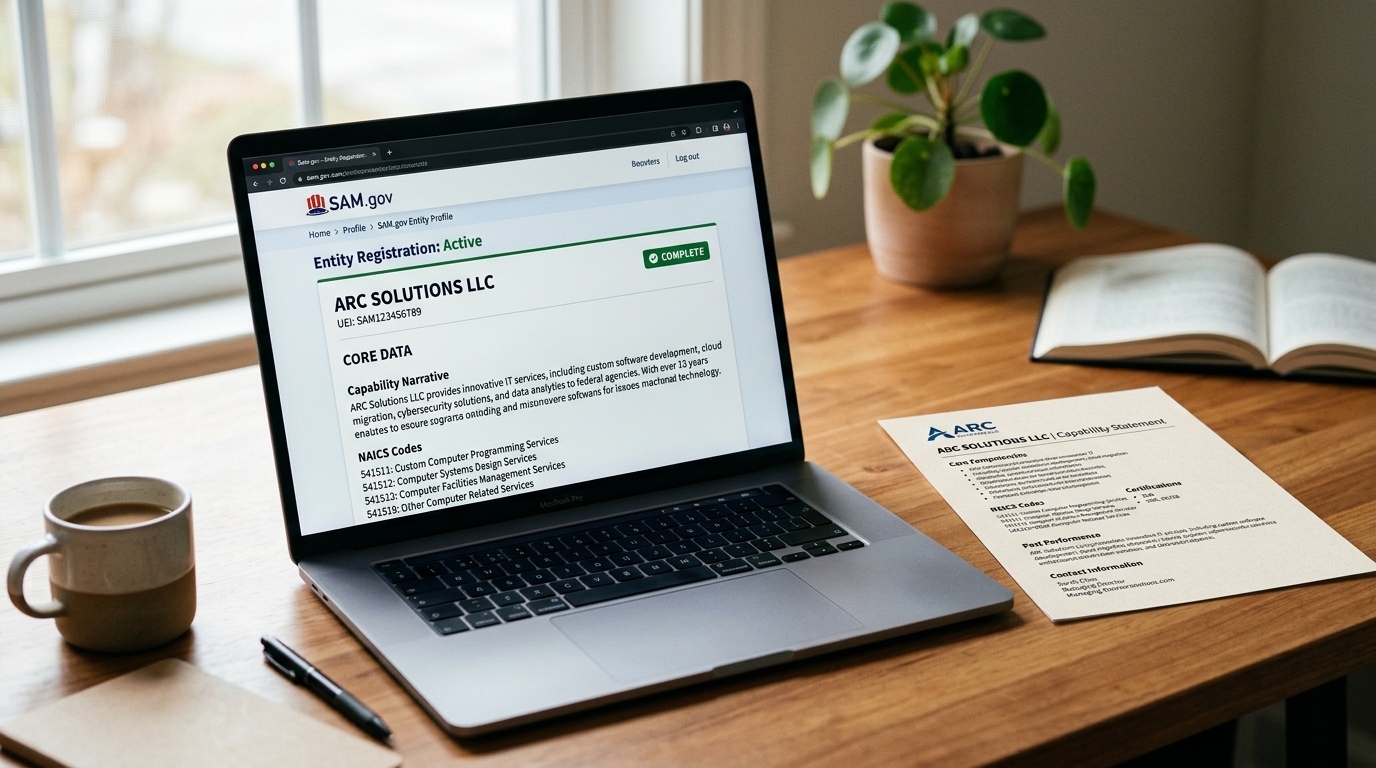
Getting your SAM.gov registration Active is the required first step — but it is not the same as being visible to federal buyers. This guide covers how to optimize your SAM profile, your Small Business Search (SBS) listing, NAICS codes, and capability narrative so the contracting officers and buyers who matter can actually find and vet your business.
New to SAM.gov registration? Start with the SAM.gov registration guide for small businesses. For NAICS code selection guidance, see how to choose NAICS codes in SAM.gov.
On this page Jump to section
Eligibility vs Visibility: The Distinction That Matters
SAM.gov registration makes you eligible to receive federal contract awards. It puts you in the federal vendor database. But eligibility and discoverability are not the same thing.
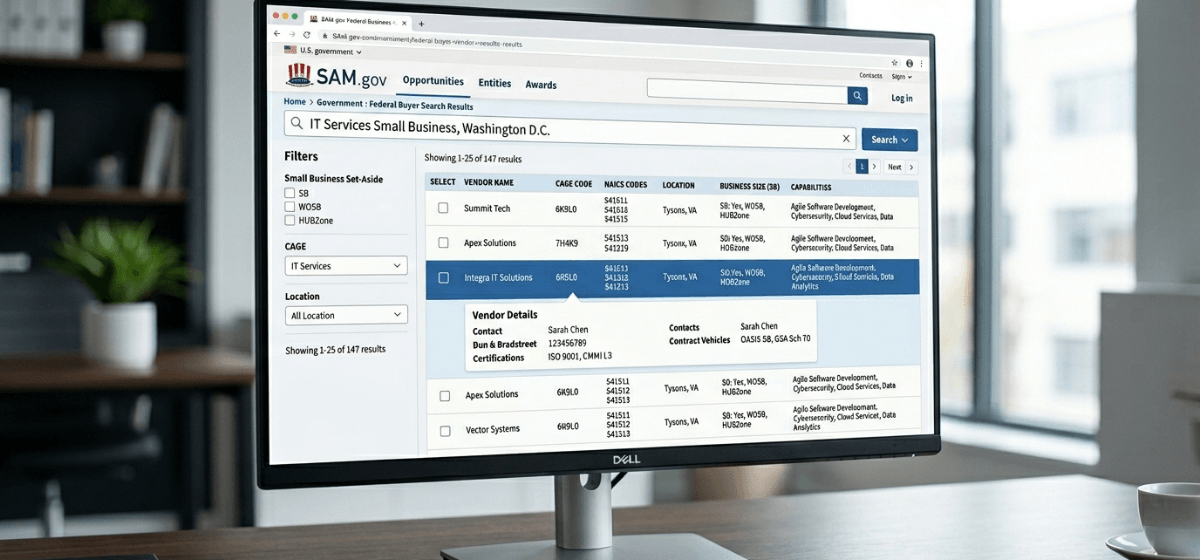
Federal buyers — contracting officers, small business specialists, and program managers — use multiple tools to find vendors before opportunities are ever posted publicly. They search the SBA Small Business Search (SBS) database, look up vendors by NAICS code, review capability narratives, and check SAM.gov entity records directly. A minimal, incomplete, or poorly written profile will not surface in those searches — even with an Active registration.
Your SBS Profile: The Visibility Layer Above SAM
The SBA Small Business Search (SBS) — formerly known as the Dynamic Small Business Search (DSBS) — is a publicly searchable database of small business vendors maintained by the SBA. Federal contracting officials are required to use it as part of market research before awarding small business set-aside contracts.
Your SBS profile is separate from your SAM.gov entity record, but connected to it. You complete and manage it through SAM.gov during or after registration. Unlike your SAM entity record — which is primarily a compliance and identity document — your SBS profile is a marketing document that buyers actively read and search.
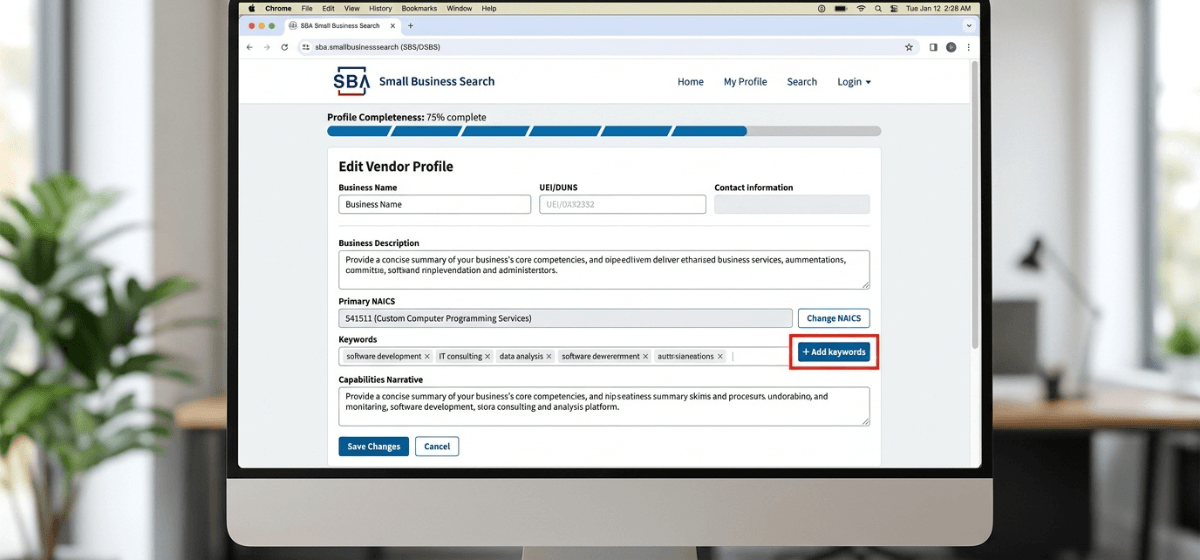
What belongs in your SBS profile
- Business description: A clear, plain-English explanation of what your business does, who you serve, and what makes you qualified. Write it for a contracting officer who does not know your industry — not for a peer who shares your jargon.
- Keywords: Specific terms that describe your capabilities, products, services, and relevant experience. Think about what a buyer would type into a search bar when looking for what you do.
- Primary and secondary NAICS codes: Accurate codes that reflect your core capabilities. See the NAICS optimization section below.
- Points of contact: A current, accessible email and phone number for your business development or contracting contact.
- Past performance (if applicable): A brief reference to relevant experience — government or commercial — that demonstrates your capability to deliver.
NAICS Code Optimization for Discoverability
Your NAICS codes are one of the primary filters buyers use when searching for vendors. Getting them right is both a compliance issue and a visibility strategy.
Select the one code that best represents your core offering — the work you most want to be found for and awarded. This is your primary discoverability signal. Choose it with buyer search behavior in mind, not just what broadly describes your industry.
Add secondary codes only for capabilities you genuinely deliver and want to be found for. Overstuffing your NAICS list with tangentially related codes signals unfocused capabilities to buyers and can actually reduce your credibility.
Common NAICS optimization mistakes
- Selecting a primary NAICS that is too broad: A NAICS code that encompasses hundreds of company types puts you in a large, undifferentiated pool. Where possible, select a more specific code that accurately represents your specialty.
- Adding codes you cannot deliver under: If a buyer filters by a NAICS code and contacts you about work in that area, you need to be able to actually perform. Codes added for exposure without capability create credibility problems.
- Not checking size standards: Each NAICS code has a size standard that determines whether you qualify as a small business under that code. Verify your size standard before finalizing your code selection. See how to choose NAICS codes in SAM.gov for the full guidance.
- Never updating codes as your business evolves: As your capabilities develop, your NAICS codes should reflect the work you are currently pursuing — not the work you did three years ago.
Writing a Capability Narrative That Works
The capability narrative in your SBS profile is the section most vendors write poorly — or leave blank entirely. It is also the section buyers actually read when deciding whether to contact you. A strong capability narrative does four things:
- States clearly what you do — in plain English, without jargon that requires domain expertise to understand.
- Specifies who you have done it for — government agencies, large primes, or commercial clients with relevant parallels to federal work.
- Describes your delivery model — how you staff, manage, and deliver the work you are describing.
- Includes relevant keywords — the specific terms, contract vehicles, agency names, and technical terminology that buyers use when searching.
What to avoid
- Generic statements like "we provide high-quality solutions to meet client needs" — these communicate nothing specific and are indistinguishable from thousands of other vendors.
- Leaving the narrative blank or at a single sentence — an empty profile is a signal that the business is not actively pursuing federal work.
- Writing the narrative for your peers rather than for a buyer who may not know your field — assume the reader is intelligent but unfamiliar with your specific domain.
SAM Profile Completeness
Beyond the SBS profile, your SAM.gov entity record itself has fields that affect how buyers see and evaluate your business. An incomplete SAM record creates doubt. A complete, accurate record signals that you are organized and serious about federal work.
Key fields to review and complete in your SAM entity record:
- Points of contact: Government Business POC and Electronic Business POC should have current, accessible email addresses and phone numbers.
- NAICS codes: Primary and secondary codes should accurately reflect current capabilities — not what was entered at initial registration if your business has evolved.
- PSC codes: Product and Service Codes classify the specific transactions — the products or services being sold. Adding relevant PSC codes improves discoverability in contract opportunity searches. See PSC codes explained.
- Architecture and Engineering services (if applicable): If your business qualifies, ensure relevant professional service classifications are accurately represented.
- Annual revenue and employee count: These fields affect size standard determinations and are reviewed by buyers assessing your business capacity.
How Federal Buyers Actually Search for Vendors
Understanding how buyers search helps you optimize for the right signals. Federal contracting officers and small business specialists use several tools and approaches in vendor market research:
- SBS keyword and NAICS search: The most common starting point. Buyers enter a NAICS code, a keyword, or both and filter by location, socioeconomic status, and certifications.
- SAM.gov entity search: Direct lookups by entity name, UEI, or CAGE code to verify registration status and review entity details.
- Past award data on USAspending.gov: Buyers research who has won contracts in a specific NAICS or service area to identify experienced vendors. Your past performance history matters more as you build it.
- Sources sought responses: When agencies post sources sought notices — requests for information before a solicitation is drafted — responding positions you directly in front of the contracting team. A well-written sources sought response is one of the most effective visibility tools available to small businesses.
- Industry days and small business events: Direct outreach and relationship-building through agency small business offices (OSDBUs) and industry events remain important supplementary channels.
Profile Optimization Checklist
Use this checklist after your SAM registration is Active to maximize your visibility to federal buyers.
SAM.gov and SBS profile checklist
Ready to build your federal contracting pipeline?
An optimized SAM profile is the foundation — but converting visibility into opportunities requires a strategy: target agencies, opportunity research, capability statement development, and a consistent outreach process. If you want expert guidance on building that pipeline, book a strategy call.
Frequently Asked Questions
What is the SBA Small Business Search and how is it different from SAM.gov?
SAM.gov is the federal vendor registration and identity system — it establishes your eligibility for awards. The SBA Small Business Search (SBS) is a searchable directory of small business vendors used by contracting officers for market research. Your SBS profile is completed through SAM.gov but functions as a separate, buyer-facing marketing record.
How many NAICS codes should I have in my SAM profile?
There is no fixed number — but more is not better. Select a primary code that accurately represents your core capability and add secondary codes only for work you genuinely deliver and want to pursue. A focused list of 3–6 well-chosen codes is more effective than a long list of tangentially related codes.
Does optimizing my SAM profile guarantee I will get contract opportunities?
No. Profile optimization improves your discoverability in federal market research — it increases the probability that buyers will find and consider you. Winning contracts still requires pursuing specific opportunities, submitting competitive proposals, and building agency relationships over time. Profile optimization is the foundation, not the finish line.
How often should I update my SAM and SBS profile?
At a minimum, review and update your profile annually as part of your SAM renewal process. Update it sooner if your capabilities, contact information, or NAICS codes change significantly. A stale profile that no longer reflects your current business is a credibility risk with buyers who research you before reaching out.
What is a sources sought notice and should I respond to them?
A sources sought notice is a request for information published by a federal agency before drafting a solicitation. Agencies use them to understand what vendors are available and capable. Responding positions you directly in front of the contracting team at the earliest stage of the acquisition process — before the competition is formally announced. For small businesses building their federal pipeline, responding to relevant sources sought notices is one of the highest-leverage activities available.