
The Representations & Certifications section of SAM.gov registration is where most businesses click through the fastest — and where some of the most consequential compliance declarations in federal contracting are made. SAM reps and certs are not administrative checkboxes. They are legal statements about your business that contracting officers rely on when evaluating eligibility and awarding contracts. This guide explains what each major section covers, what you are agreeing to, and the mistakes that create problems later.
For the complete SAM.gov registration reference — UEI, CAGE code, entity validation, and step-by-step workflow — see the SAM.gov registration guide for small businesses.
On this page Jump to section
SAM Reps & Certs: Quick Answer
SAM.gov Representations & Certifications (Reps & Certs) are the section of your entity registration where you make formal legal declarations about your business — including your size, ownership, compliance status, and eligibility for set-asides and sole-source awards. These declarations are incorporated by reference into federal contracts and carry legal weight. They must be accurate at the time of submission and kept current through annual renewal.
What Reps & Certs cover
What Reps & Certs Are and Why They Exist
Representations & Certifications are formal legal declarations required under the Federal Acquisition Regulation (FAR). FAR Part 4.12 establishes the requirement for vendors to complete and maintain annual representations and certifications through SAM.gov as a condition of federal contracting eligibility.
The system exists to create a standardized, on-record compliance baseline that contracting officers can rely on during source selection and award. Rather than asking every vendor to re-certify for every solicitation from scratch, SAM.gov serves as the central repository for these declarations — and they apply across federal procurement by reference.
How they are used in practice
- Incorporated into contracts: when you win a federal award, the Reps & Certs on file in SAM.gov at the time of award become part of the legal record of that contract
- Used during source selection: contracting officers review size certifications, exclusion status, and set-aside eligibility before making award decisions
- Applied across solicitations: you generally do not re-complete Reps & Certs for every bid — your SAM.gov record applies, unless a specific solicitation requires updated or additional certifications
- Subject to annual reconfirmation: at every annual SAM renewal, you are certifying that your Reps & Certs remain accurate as of the renewal date
The Major Sections of Reps & Certs
The Reps & Certs section in SAM.gov is divided into several distinct areas. Each covers a different category of compliance declaration. Below is a plain-English breakdown of what each major section asks, what you are confirming, and where errors most commonly occur.
Business size and size standard certifications
Your declaration of whether your business qualifies as "small" under the SBA size standard applicable to your primary NAICS code. Size standards vary significantly by industry — what makes a business "small" under one NAICS code may not apply under another.
What it determines: small business status affects set-aside eligibility, certain reporting requirements, and sole-source thresholds across the federal contracting system.
Important nuance: size is certified at SAM registration, but size re-certifications may also be required at contract award for certain contract vehicles. Your SAM registration establishes the baseline; specific solicitations may trigger additional review.
Common error: incorrect primary NAICS leads to wrong size certification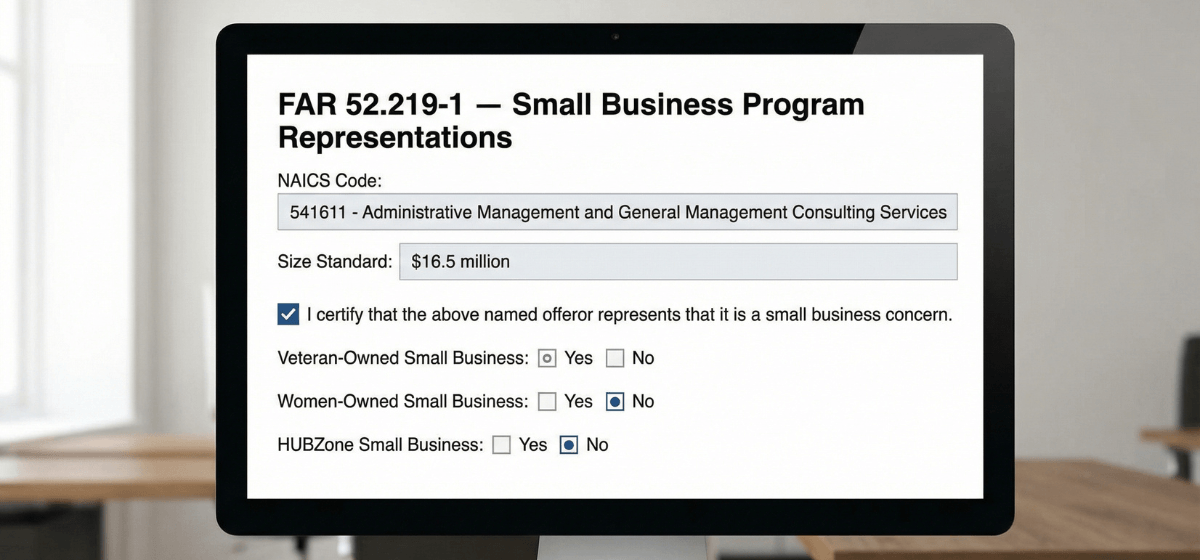
Small business program eligibility certifications
Declarations of eligibility for specific small business programs — including women-owned (WOSB/EDWOSB), veteran-owned (VOSB/SDVOSB via VetCert), HUBZone, and 8(a). These certifications determine your eligibility for set-aside and sole-source opportunities reserved for those programs.
Critical distinction: self-certifying eligibility in SAM.gov Reps & Certs is not the same as holding a formal certification from SBA or VA. For programs that require formal certification — WOSB, VetCert, 8(a), HUBZone — you must have completed and been approved for that program before claiming that status in Reps & Certs.
For an overview of how set-aside programs work and which certifications require formal SBA or VA approval, see small business set-asides explained.
Common error: claiming set-aside eligibility without formal certification in placeOwnership and control declarations
Declarations about who owns and controls the business — including whether it is domestically owned, majority-owned by specific categories, and whether there are any foreign interests or foreign control issues.
Why it matters: certain contract types and agency requirements restrict awards to businesses with specific ownership structures. Defense and national security contracts in particular may have additional ownership requirements.
Common error: answering based on operational control rather than legal ownership structureExclusions and debarment status
Certification that your business, its principals, and its owners are not currently debarred, suspended, or otherwise excluded from federal contracting. This is one of the most scrutinized sections during any award process.
How contracting officers use it: contracting officers check the SAM.gov exclusions list before every award. An incorrect certification here is among the most serious compliance failures in federal contracting.
How to verify before certifying: check the SAM.gov exclusions database directly — both for your own entity and for any principals (owners, officers, directors). Do not certify based on assumption.
Common error: certifying without running an exclusions check first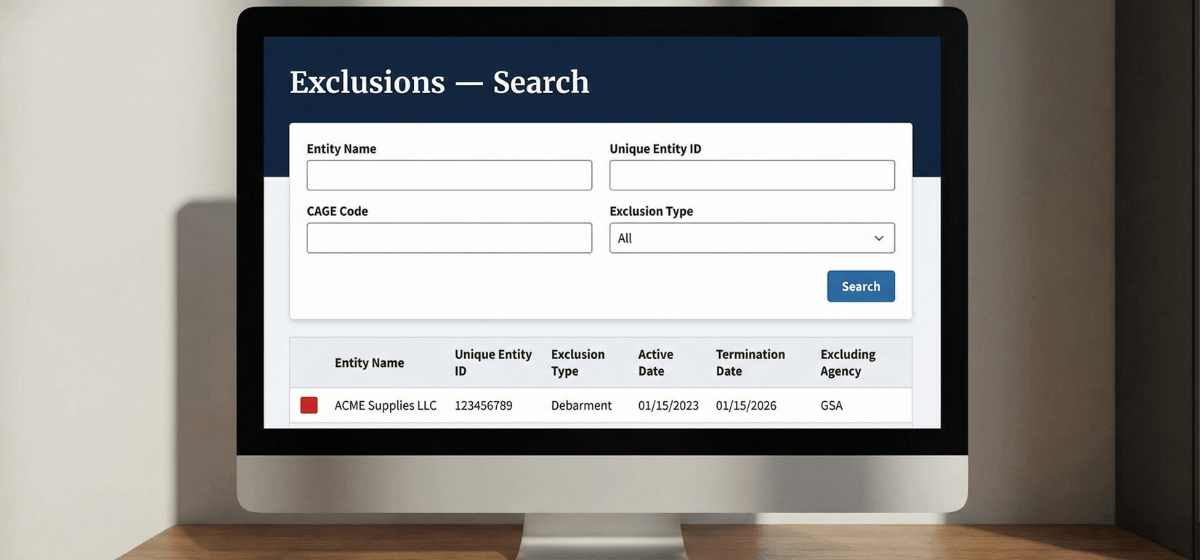
FAR and DFARS compliance representations
A series of compliance representations required under specific FAR and DFARS clauses. These cover a broad range of topics including equal opportunity, affirmative action programs, drug-free workplace, anti-kickback, subcontracting plan requirements, and procurement integrity requirements.
Why the detail matters: these representations are incorporated by reference into contracts. Inaccurate representations create legal exposure regardless of whether a specific clause was negotiated or flagged during contract execution.
What to do before certifying: read each representation. For representations about operational practices — drug-free workplace policies, equal opportunity programs — confirm that your actual business practices match what you are certifying.
Common error: answering what seems like the "right" answer rather than verifying actual business practicesCommon SAM Reps & Certs Mistakes
These are the errors that appear most often — and that create the most significant downstream compliance problems. Most are preventable with careful reading and proper preparation.
Reps & Certs at Annual Renewal
Reps & Certs must be reviewed and reconfirmed at every annual SAM registration renewal. The renewal is not a passive reconfirmation — it is a new certification of accuracy as of the renewal date.
What to review at renewal time
- Business size: has your revenue or employee count changed in a way that affects your size classification under your primary NAICS?
- Program certifications: are all set-aside program certifications you're claiming still active and in good standing? Have any certifications lapsed or been revoked?
- Ownership structure: has ownership or control of the business changed in any way since your last registration?
- Exclusions: run a fresh exclusions check for your entity and principals — don't assume nothing has changed
- FAR/DFARS representations: have your business practices or compliance programs changed in any way that would affect these representations?
What to Do After Completing Reps & Certs
Document your answers
Keep an internal record of what you certified and when. This creates a baseline for renewal consistency and provides a reference point if your answers are ever questioned during a compliance review or contract audit. A simple spreadsheet or operations document is sufficient.
Align your internal records
Confirm that your operating agreements, ownership documents, and compliance policies are consistent with your certifications. If a contracting officer requests supporting documentation during source selection, those records need to match what is on file in SAM.gov.
Continue your registration
After completing Reps & Certs, the next step is confirming your EFT banking details and submitting your registration. See EFT and banking setup in SAM.gov to complete that section correctly.
Frequently Asked Questions About SAM Reps & Certs
What are Reps & Certs in SAM.gov?
Representations & Certifications (Reps & Certs) are formal legal declarations you make as part of SAM.gov entity registration, required under the Federal Acquisition Regulation. They cover business size, ownership, set-aside eligibility, exclusion status, and FAR compliance representations. They are incorporated by reference into federal contracts and must be accurate at submission and kept current through annual renewal.
Are Reps & Certs legally binding?
Yes. Reps & Certs are formal certifications under federal law. They are incorporated by reference into contract awards. Inaccurate certifications — even unintentional — can create compliance and legal consequences, including potential false claims exposure in serious cases. Accuracy is required, not approximate.
How often do I need to update my Reps & Certs?
Reps & Certs must be reviewed and reconfirmed at every annual SAM renewal. You should also review them if your business ownership, size, certification status, or compliance posture changes between renewals. Simply reconfirming the same answers at renewal without reviewing is a common mistake — renewal is a new certification of accuracy as of that date.
Can I self-certify as a small business in SAM.gov?
Yes — size status is self-certified in SAM.gov based on the SBA size standard for your primary NAICS code. However, specific programs such as WOSB, SDVOSB (via VetCert), 8(a), and HUBZone require formal certification from SBA or VA. You cannot claim those program statuses in Reps & Certs without holding the required formal certification from the relevant agency.
What happens if my Reps & Certs are inaccurate?
Inaccurate certifications create compliance and legal exposure. At minimum, they can affect your eligibility for awards or require corrective action. In cases involving intentional misrepresentation — particularly false small business status claims or false exclusion certifications — the legal consequences can be significant. Accuracy matters in every section, not just the ones that seem most important.
Do I need to complete Reps & Certs again for every contract I bid on?
Not typically. Your SAM.gov Reps & Certs apply across federal procurement by reference under FAR Part 4.12. Some solicitations may require updated or additional certifications specific to that contract — read the solicitation instructions carefully. Your annual SAM registration covers the standard representations for most federal procurements.
Want to make sure your Reps & Certs are accurate before you submit?
Reps & Certs is the section where an experienced review matters most. If you want help confirming your registration is accurate and complete before submission — or you want a done-for-you workflow that handles the full process — the options below are the fastest path to an Active, compliant registration.
Author: Biz2Gov Editorial Team · Reviewed by: Former DoD Contracting Officer advisor · Sources: FAR Part 4.12, SAM.gov entity registration, SAM.gov help