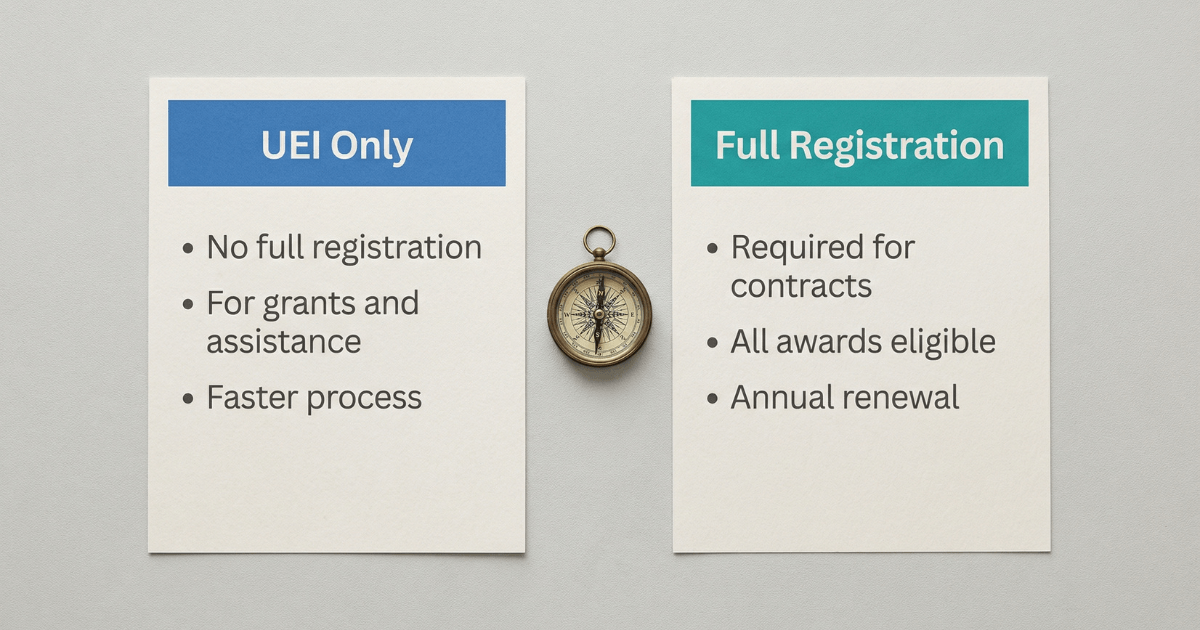
SAM.gov offers two distinct paths: a UEI-only request and a full entity registration. Many businesses don't realize the difference exists — or assume they need one when they actually need the other. This guide explains what each path provides, who needs which, and how to avoid registering for more — or less — than your situation actually requires.
For the complete SAM.gov registration reference — entity validation, CAGE code, Reps & Certs, and renewal — see the SAM.gov registration guide for small businesses. New to federal contracting? Start with federal contracting for beginners.
On this page Jump to section
UEI Only vs Full SAM Registration: Quick Answer
A UEI-only request gives you a federal identifier but does not make you eligible for prime contract awards or full federal payments. A full SAM registration — resulting in an Active entity record — is required for prime contracts, grants as a primary recipient, and direct federal payments. Subcontractors and some lower-tier program participants may only need a UEI.
| I need to… | UEI Only | Full SAM Registration |
|---|---|---|
| Receive a prime contract award | ✗ | ✓ |
| Receive a federal grant (as prime recipient) | ✗ | ✓ |
| Receive direct federal payments | ✗ | ✓ |
| Appear in SAM entity searches by buyers | ✗ | ✓ |
| Satisfy subcontract reporting UEI requirement | ✓ | ✓ |
| Apply for certain lower-tier assistance | ✓ | ✓ |
The Two Paths: What Each One Is
Understanding the difference starts with knowing what each path actually delivers. For a full explanation of what a UEI is and how it works, see what is a UEI number.
- 12-character federal identifier assigned to your entity
- No Active registration status
- No Reps & Certs on file
- No EFT banking setup
- Not eligible for prime awards or payments
- Not visible in SAM entity searches
- Useful for: subcontract reporting, lower-tier assistance
- UEI assigned (same identifier)
- Active entity record in SAM.gov
- Reps & Certs completed on file
- EFT banking setup for federal payments
- Eligible for prime contract awards and grants
- Visible in SAM entity searches by contracting officers
- Required for: prime contracts, grants, federal payments
Who Needs UEI Only
The UEI-only path is appropriate in specific, well-defined situations. Outside of those situations, the full registration is almost always the right choice.
Subcontractors under a prime contractor
Prime contractors are required to report their subcontractors' UEIs in federal reporting systems. If you are subcontracting under a prime and your prime needs your UEI for compliance reporting — but you are not receiving a direct federal award or payment yourself — a UEI-only request may satisfy the requirement.
Always confirm with your prime contractor exactly what they need before choosing this path. Some primes require subcontractors to have a full Active SAM registration, not just a UEI.
Lower-tier grant participants
Some federal assistance programs require lower-tier participants to have a UEI without requiring full SAM registration. Verify the specific program requirements before assuming UEI-only is sufficient — requirements vary by program and funding agency.
Businesses not yet ready to register fully
If your business plans to pursue federal contracting but is not yet ready for full registration — for example, your IRS records are not in order, your entity formation is still pending, or your address situation needs to be resolved — obtaining a UEI establishes your identifier in the system without triggering the full registration timeline.
That said: if there is any chance you will pursue prime work or need an Active registration within the next 12 months, completing the full registration now is the more efficient path. The time saved by doing UEI-only is rarely worth the delay when a real opportunity appears.
Who Needs Full SAM Registration
Full SAM registration — resulting in an Active entity record — is required in all of the following situations. If any one of these applies to you, UEI-only is not sufficient.
You need full SAM registration if you are:
How to Get Each One
Getting a UEI only
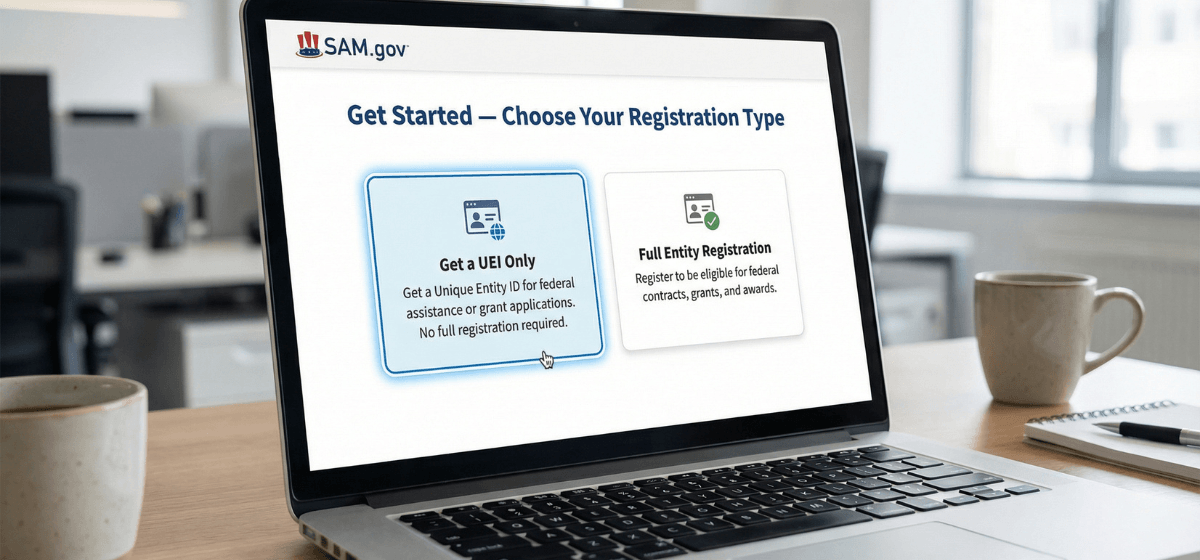
Use your exact legal name as it appears on your IRS EIN confirmation letter. Inconsistencies here can cause the same validation issues as a full registration.
Record your UEI immediately and share it with whoever needs it — your prime contractor, grant program office, or internal operations team.
Getting a full SAM registration
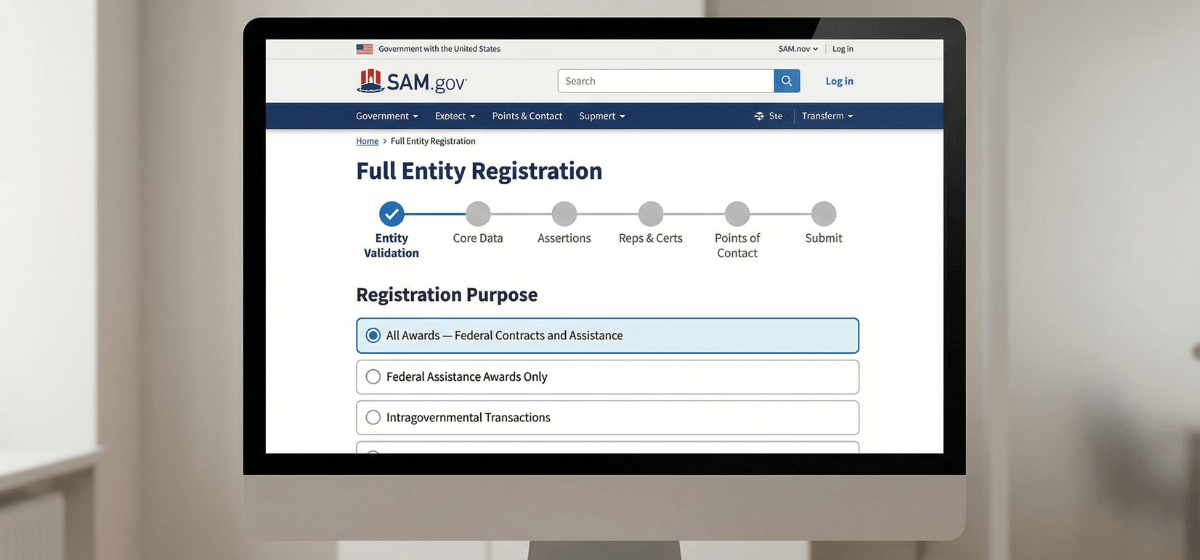
The full registration process covers legal entity details, entity validation, NAICS code selection, Representations & Certifications, and EFT banking setup. The complete step-by-step workflow — including what to prepare and how to avoid common delays — is covered in how to register in SAM.gov.
If your registration stalls during entity validation — the most common delay point — see entity validation in SAM.gov: why it fails and how to fix it for the full resolution workflow.
Converting from UEI Only to Full Registration
If you obtained a UEI-only and now need a full Active registration, the process is straightforward — and your UEI does not change.
- Your UEI carries over. You do not receive a new identifier when you complete full registration. The same UEI is used throughout.
- You complete the remaining steps. Log in to SAM.gov and continue the registration workflow from your existing entity record — the steps you skipped during UEI-only are now required.
- Plan for the standard registration timeline. Converting from UEI-only to full registration follows the same process and timeline as a new full registration. There is no expedited path.
- Gather your documents before you start. Have your IRS EIN confirmation letter, state formation document, NAICS codes, and banking details ready before you begin — the same preparation that applies to any new registration.
Frequently Asked Questions
Do subcontractors need a full SAM registration?
Not always. Subcontractors may only need a UEI if their prime contractor requires it for reporting purposes. However, if you plan to pursue prime contracts in the future, or if your prime requires a full Active registration, completing the full registration is the better long-term choice. Always confirm requirements directly with your prime contractor before choosing a path.
Can I get a UEI without registering in SAM.gov?
Yes. SAM.gov allows you to request a UEI without completing a full entity registration. This option is available for entities that need a federal identifier for reporting or lower-tier assistance purposes but do not need an Active registration for prime awards or direct payments.
Is a UEI-only request free?
Yes. Both the UEI-only request and full SAM registration are completely free through SAM.gov. No payment is required for either path. Any service charging a fee to obtain a UEI or complete SAM registration is offering optional paid assistance — it is not required.
If I have a UEI, am I registered in SAM.gov?
Not necessarily. Having a UEI means you have a federal identifier in the SAM system, but it does not mean you have an Active entity registration. An Active registration requires completing the full entity registration process, including entity validation, Reps & Certs, and EFT banking setup. A UEI-only record and a full Active registration are different things.
What happens to my UEI if I complete a full registration later?
Your UEI stays the same. When you convert from a UEI-only record to a full registration, you use the same entity record and the same 12-character UEI — you are completing the steps you initially skipped. No new identifier is issued.
Not sure which path is right for you?
If your situation involves a mix of subcontracting, grant applications, and potential prime work, it can be hard to know which registration path makes the most sense right now. A strategy call is the fastest way to get a clear answer for your specific situation. If you are ready to complete your full SAM registration, the done-for-you service handles the entire process from start to Active.
Author: Biz2Gov Editorial Team · Reviewed by: Former DoD Contracting Officer advisor · Sources: SAM.gov entity registration, SAM.gov help, GSA UEI update