Finding Contract Opportunities · Notice Types
Understanding RFI vs RFP vs RFQ — and where Sources Sought fits — is what tells you whether a SAM.gov notice needs a one-page reply, a price quote, or a full proposal. Each notice type is a different stage of the buying process, and each calls for a different move. This guide is part of our pillar on how to get government contracts.
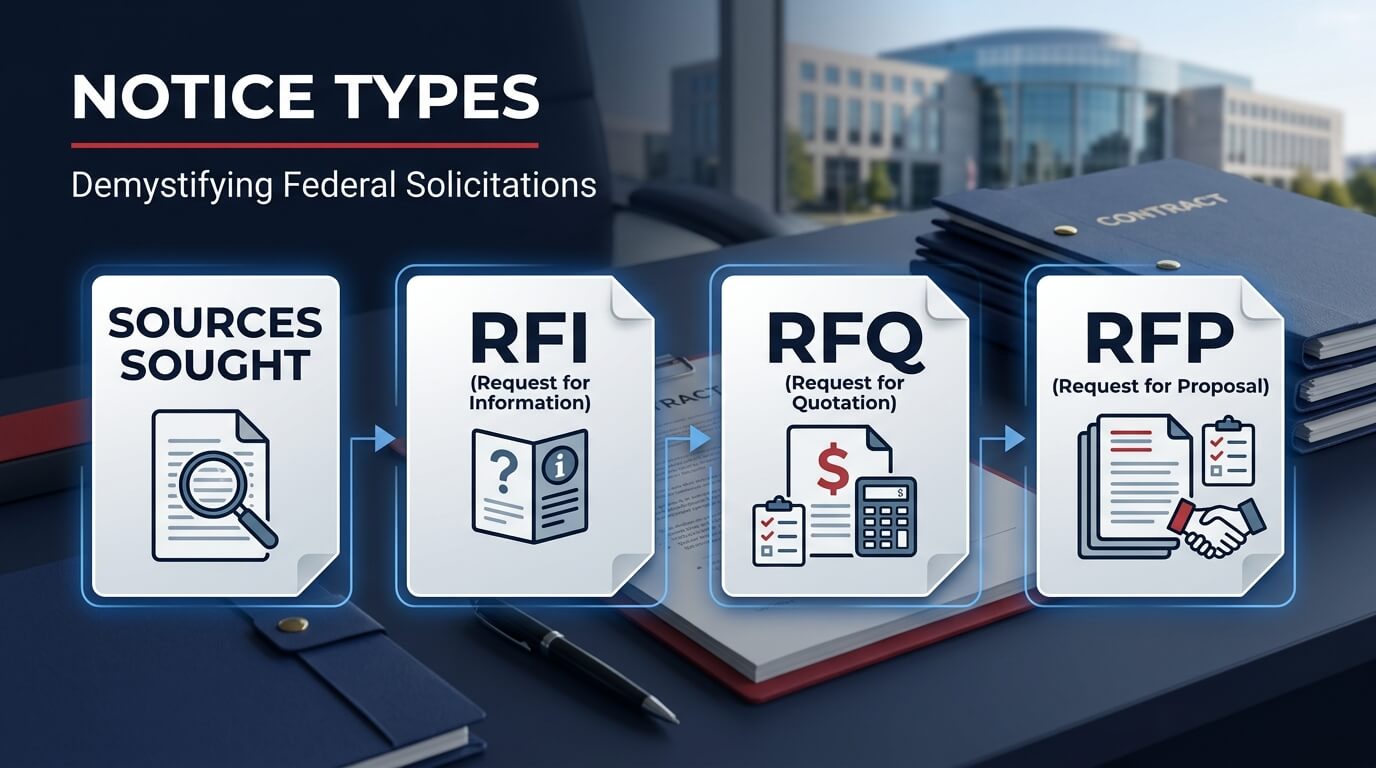
A Sources Sought and an RFI are market research — the agency is exploring, not buying yet, and a short capability response gets you on the radar. An RFQ asks for a price quote on a defined item, common for simpler or lower-dollar buys. An RFP is a full solicitation requesting a complete proposal evaluated on price and other factors. Match your effort to the stage.
The Four Notice Types at a Glance
| Notice | What it is | What it asks for | Your move |
|---|---|---|---|
| Sources Sought | Market research before a solicitation exists | Proof that capable (small) businesses exist | Respond with a short capability statement to shape the set-aside |
| RFI (Request for Information) | Market research / planning | Information, feedback, sometimes pricing ranges | Answer to build a relationship; no bid is awarded from an RFI |
| RFQ (Request for Quote) | A buy of a defined product/service | A price quote against stated requirements | Quote if it fits; often faster, lower-dollar work |
| RFP (Request for Proposal) | A full competitive solicitation | A complete proposal (technical + price) | Bid/no-bid decision, then a full response if you pursue |
The same opportunity often moves through these stages over months — Sources Sought or RFI first, then RFQ or RFP. Getting in early is the whole advantage.
Sources Sought Notices
A Sources Sought notice is how an agency conducts market research before writing a solicitation. It's asking a single question: do capable businesses — especially small businesses — exist for this requirement? Your response is typically a short capability statement, not a proposal. This is the most valuable and most under-used notice type, because a strong response can influence whether the eventual contract is set aside for small business at all. The full playbook is in how to use Sources Sought to get on an agency's radar.
RFI — Request for Information
An RFI is also market research. The agency is gathering information to shape its approach, and no contract is awarded directly from one. Responding is still worth it: it puts your name in front of the contracting office and can inform how the requirement is written. Treat it as a relationship-building and positioning move, not a sale.
RFQ — Request for Quote
An RFQ means the agency is ready to buy a defined product or service and wants a price. RFQs are common in simplified acquisitions and lower-dollar buys, which makes them a strong entry point for newer contractors — the requirements are usually clearer and the response lighter than a full proposal. If the requirement fits what you do, quote it.
RFP — Request for Proposal
An RFP is the full solicitation. It requests a complete proposal — technical approach, staffing, past performance, and price — evaluated against stated criteria (often on best value rather than lowest price alone). RFPs are the most work, so they deserve a real bid/no-bid decision before you commit. Learn to triage one quickly in how to read a solicitation fast.
You may also see presolicitation and special notices — early heads-ups that a solicitation is coming or that an industry day is scheduled. Treat these as timing signals to prepare.
New contractors routinely make two opposite mistakes: they pour proposal-level effort into an RFI that awards nothing, and they ignore the Sources Sought that could have gotten the work set aside for a business like theirs. Read the notice type first. It tells you exactly how much to spend and what the agency actually wants back.
Want a shortcut to a working pipeline?
Biz2Gov helps small businesses go from unregistered to a running opportunity pipeline — hands-on implementation, not just advice. Founded by former DoD Contracting Officer Bruce Ayres.
Frequently Asked Questions
What is the difference between an RFI, RFP, and RFQ?
An RFI (Request for Information) is market research and awards nothing. An RFQ (Request for Quote) asks for a price on a defined item, common for simpler or lower-dollar buys. An RFP (Request for Proposal) is a full solicitation requesting a complete proposal evaluated on price and other factors.
What is a Sources Sought notice?
A Sources Sought notice is market research an agency conducts before writing a solicitation, to find out whether capable businesses — especially small businesses — exist for a requirement. Responding with a short capability statement can influence whether the contract is set aside for small business.
Do I win a contract by responding to an RFI or Sources Sought?
No. Neither one awards a contract. Both are market research. Responding gets you on the agency's radar early and can shape how the eventual solicitation is written, which improves your position when the RFP or RFQ posts.
Which notice type is best for a new contractor?
RFQs tied to simplified acquisitions are often the easiest entry point because requirements are clearer and responses are lighter. Sources Sought notices are the best early-positioning tool, even though they don't award work directly.