Finding Contract Opportunities · Pillar Guide
Learning how to get government contracts starts with knowing where the opportunities actually live. The U.S. government is the largest buyer of goods and services on earth — over $755 billion a year at the federal level alone, with a legal minimum of 23% reserved for small businesses. But that spending doesn't sit behind a single "apply here" button. Government contract opportunities are scattered across posted solicitations, public award data, agency forecasts, and prime-contractor relationships — and the businesses that win are the ones who know where to look and check on a schedule. This guide is the complete map, and it points you to a step-by-step walkthrough for each source.
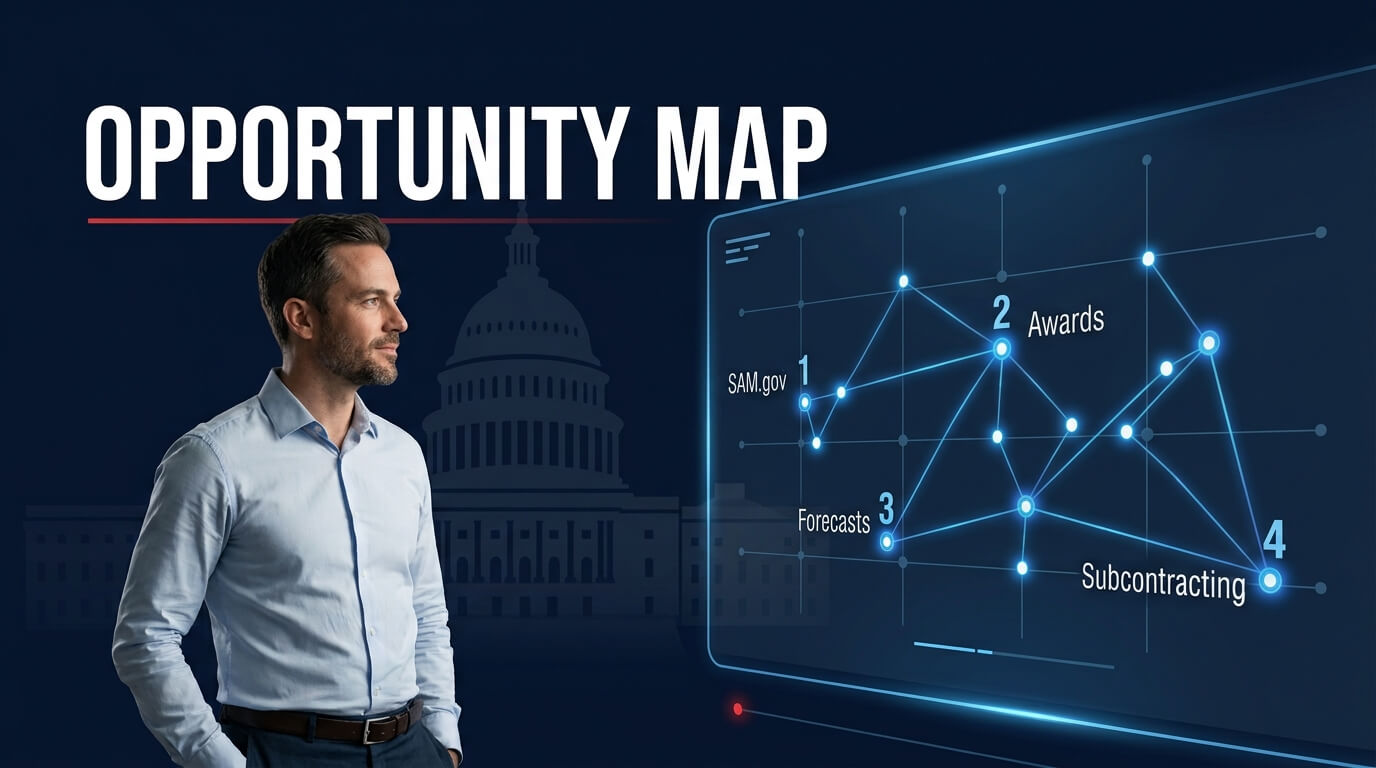
To get government contracts, start by searching SAM.gov — but know that open solicitations are only one layer. Much of the work is shaped earlier, through award data (now consolidated into SAM.gov), agency forecasts, Sources Sought notices, and subcontracting relationships with prime contractors. Businesses that win consistently monitor all of these on a weekly schedule, not just SAM.gov's opportunity feed.
The government market at a glance: about $755B in federal contract obligations in FY2024 — with over $183B going to small businesses, roughly a quarter of all dollars — plus hundreds of billions more across the SLED market. Source: SBA FY2024 Small Business Procurement Scorecard.
On this page Jump to section
What "Finding Opportunities" Actually Means
Most people picture government contracting as a single act: find an open bid, submit a proposal, win the work. That happens — but it's the narrowest and most competitive slice of the market. By the time a solicitation is posted publicly, the agency has usually spent months planning, and a well-positioned competitor often already has the relationship.
Finding opportunities well means working three layers at once:
- Posted solicitations — the open bids anyone can find and respond to on SAM.gov.
- Pre-solicitation intelligence — award history, forecasts, and market-research notices that tell you what's coming before it posts.
- Relationships — subcontracting under a prime, and face time with buyers, that put you in the room before the competition.
A business that only watches posted solicitations is playing the hardest version of the game. This guide covers all three layers so you can choose where to compete.
The Five Places to Find Government Contract Opportunities
Here is the whole landscape at a glance. Each source below links to a dedicated, step-by-step guide.
SAM.gov Contract Opportunities
Every open federal solicitation, RFI, and Sources Sought notice. The official front door.
Award Data (SAM.gov & USAspending.gov)
Who has bought what, from whom, and for how much — your best predictor of future buys.
Agency Forecasts
Contracts an agency plans to award in the coming year, so you can pre-position early.
Subcontracting & Teaming
Work available under a prime's existing contract — the fastest route to first revenue.
State, Local & Education (SLED)
Thousands of non-federal government buyers — often an easier parallel market.
The five sources of government contract opportunities. Most new contractors start with SAM.gov and award data, then layer in forecasts, subcontracting, and outreach as their pipeline matures.
Start With SAM.gov — the Front Door
SAM.gov (the System for Award Management) is the federal government's official site for both registering your business and searching contract opportunities. Every civilian and defense agency is required to post competitive opportunities above the micro-purchase threshold here, which makes it the single most important place to look.
One point that trips up beginners: you do not need to be registered to search SAM.gov — searching and browsing opportunities is free and public. You only need an active registration when you're ready to submit a bid or receive an award. So you can start researching today, even while your SAM.gov registration is still processing.
The mechanics — running your first search, choosing keywords, and saving searches with email alerts — are covered in how to search contract opportunities on SAM.gov. The difference between noise and a usable pipeline is the filters: see the SAM.gov filters that actually matter. And because a Sources Sought notice, an RFI, an RFQ, and an RFP each call for a different action, start with notice types explained.
When I was a contracting officer, by the time I posted a solicitation I usually already knew which vendors were capable — because they'd answered my Sources Sought notice, shown up at an industry day, or I'd seen them in the award data. The companies that were invisible until the RFP dropped were almost always too late. Finding opportunities isn't about refreshing SAM.gov all day. It's about being a known quantity before the notice ever posts.
Look Beyond SAM: Find Out Who's Already Buying
Posted opportunities tell you what's open today. Award data tells you what an agency actually buys, how often, at what price, and from whom — the single best predictor of what they'll buy next. This is where most small businesses under-invest, and where the real targeting advantage lives.
There are two public sources, and it's worth knowing how they now fit together:
- SAM.gov contract award search. As of February 24, 2026, the old Federal Procurement Data System (FPDS.gov) was decommissioned and its public contract-award search was consolidated into SAM.gov. SAM.gov is now the authoritative place to search individual federal contract award records. You'll need a free SAM.gov account to view award data, even as a public user.
- USAspending.gov. The government's open-data site for all federal spending — contracts, grants, and loans — best for government-wide trends and totals.
Start with the concept in where to find contract award history and why it matters, then follow the hands-on tutorial in how to research who buys what on USAspending.gov. If you're unsure which source to trust after the FPDS change, SAM contract data vs FPDS lays it out. Award data also tells you who currently holds the work — see finding incumbents and likely competitors — and when you're ready to focus, how to build a target agency list narrows you from "the whole government" to the 5–10 buyers you can actually win with.
The fastest education in your market is the award data. Pull who has won the work you want over the last few years and you'll see the real buyers, the incumbents, and roughly what they pay. Then go find the primes on those awards — that's often your first contract, as a subcontractor, long before you'd win one as a prime.
Get Ahead of the RFP: Forecasts and Sources Sought
The earlier you learn about an opportunity, the better your odds. Two tools let you see around the corner.
Agency procurement forecasts are public lists of contracts an agency plans to award in the coming fiscal year — often with the anticipated quarter, estimated value, NAICS code, and set-aside intent. They aren't guarantees and timelines slip, but they let you pre-position months ahead. See forecasts explained for where to find them and how to read an entry.
Sources Sought notices are how agencies conduct market research before writing a solicitation. Responding tells the agency you exist, demonstrates capability, and — when enough qualified small businesses respond — can lead the agency to set the eventual contract aside for small business. On the discovery side, how to use Sources Sought to get on an agency's radar covers finding them, reading them, and deciding when to raise your hand.
The Fast Path In: Subcontracting and Teaming
For most businesses in their first 12–18 months, the quickest route to federal revenue isn't winning a prime contract — it's subcontracting under a company that already holds one. Primes on larger contracts actively look for qualified small businesses to meet work requirements and subcontracting goals, and the experience builds the federal past performance that makes you competitive as a prime later.
If you're weighing which path to pursue first, the prime vs. subcontractor breakdown is a good primer. When you're ready to pursue it, how to find teaming partners and primes to sub under shows you where to look and how to approach them. And don't overlook face-to-face channels — industry days and vendor outreach events are where buyers meet vendors before the RFP.
Don't Forget SLED: State, Local & Education Opportunities
Federal isn't the only government market — and for many small businesses it isn't even the easiest place to start. SLED stands for State, Local, and Education: the thousands of state agencies, counties, cities, school districts, and public universities that also buy from private vendors. Where the federal market is one buyer with one rulebook (the FAR) and one registration (SAM.gov), SLED is thousands of separate buyers, each with its own portal, rules, and certifications.
Neither market is better — they simply suit different businesses. Federal contracts tend to be larger, with longer sales cycles and nationwide reach from a single registration. SLED contracts tend to be smaller and more frequent, with faster cycles and a strong advantage for local businesses close to the buyer. If you're near a state capital, a large school district, or a public university system, SLED opportunities may sit right in your backyard — and they don't require you to compete nationally to win them.
Finding SLED opportunities works differently: instead of one SAM.gov, you monitor individual state and local procurement portals, cooperative purchasing sites, and bid boards. It's a genuine parallel pipeline worth building alongside your federal search. For a fuller comparison of the two markets, see what is SLED? state, local & education contracting explained.
Is It Winnable? A First Look at Bid/No-Bid
Finding opportunities is only half the skill; the other half is knowing which ones to skip. Chasing every posted bid burns time you don't have and drags down your win rate. Experienced contractors treat "no-bid" as a strategy — they qualify hard and pursue few.
Watch for red flags: an unrealistically short response window, specifications that seem written around one vendor, requirements that don't match your NAICS or capabilities, or terms (bonds, clearances, past-performance minimums) you can't meet yet. Opportunity red flags: bids you should skip gives you a scorecard to make the call fast — and before you commit, how to read a solicitation fast shows you which sections decide the win.
Turn It Into a Weekly Pipeline
The difference between businesses that win and businesses that stall is rarely talent — it's consistency. Opportunities expire, forecasts update, and Sources Sought notices come and go in days. Someone has to own the pipeline and work it on a schedule.
A working system looks like this: saved SAM.gov searches with email alerts running in the background, a weekly review to triage what came in, a simple bid/no-bid gate on each opportunity, and a tracker that follows every live pursuit from identified to submitted. Build yours with building a bid pipeline: from search to weekly review. If you're just starting, the first 90 days plan puts registration, research, and your first bids in order.
The most common reason businesses stall isn't a bad opportunity — it's the absence of an internal owner for pipeline activity. Alerts go unread, warm agencies go cold, and deadlines pass. Assign one person to touch the pipeline every week. That single habit separates the contractors who win from the ones who keep "getting ready."
Ready to Find the Right Opportunities?
Biz2Gov helps small businesses go from unregistered to a running opportunity pipeline. Founded by former DoD Contracting Officer Bruce Ayres, we provide hands-on implementation — not just advice.
Frequently Asked Questions
Where do I find government contract opportunities?
Open federal solicitations are posted on SAM.gov, the government's official contracting site. Beyond posted bids, opportunities also surface through federal award data (now searchable in SAM.gov and on USAspending.gov), agency procurement forecasts, and subcontracting relationships with prime contractors. Winning consistently means monitoring all of these, not just SAM.gov.
Do I have to be registered in SAM.gov to search for contracts?
No. Searching and browsing contract opportunities on SAM.gov is free and public. You only need an active SAM.gov registration when you're ready to submit a bid or receive an award, so you can begin researching immediately.
Is there a cost to find or register for government contracts?
No. Registering, renewing, and searching on SAM.gov are all free. The government never charges a fee for these. Any site or email charging you to "register in SAM" or "find contracts for you" is not the official system — use SAM.gov and the Federal Service Desk (fsd.gov) directly, or a transparent advisor.
What happened to FPDS for researching past contract awards?
FPDS.gov's public contract-award search was decommissioned on February 24, 2026, and consolidated into SAM.gov. SAM.gov is now the authoritative place to search individual federal contract award records; USAspending.gov remains the source for government-wide spending trends.
How long does it take to win a first federal contract?
It varies, but most businesses that work a consistent pipeline see their first opportunities within a few months and a first prime award in roughly 6–18 months. Subcontracting under a prime is usually the fastest route to initial federal revenue and past performance.
Continue Learning